
Executive Job Search
What Employers See When Your Resume and LinkedIn Don't Align
A hiring-side perspective on the inconsistencies employers notice — and why alignment between your resume and LinkedIn profile matters more than most candidates realize.
“If I'm seeing that during a Strategy Session, an employer or recruiter can see it too.”
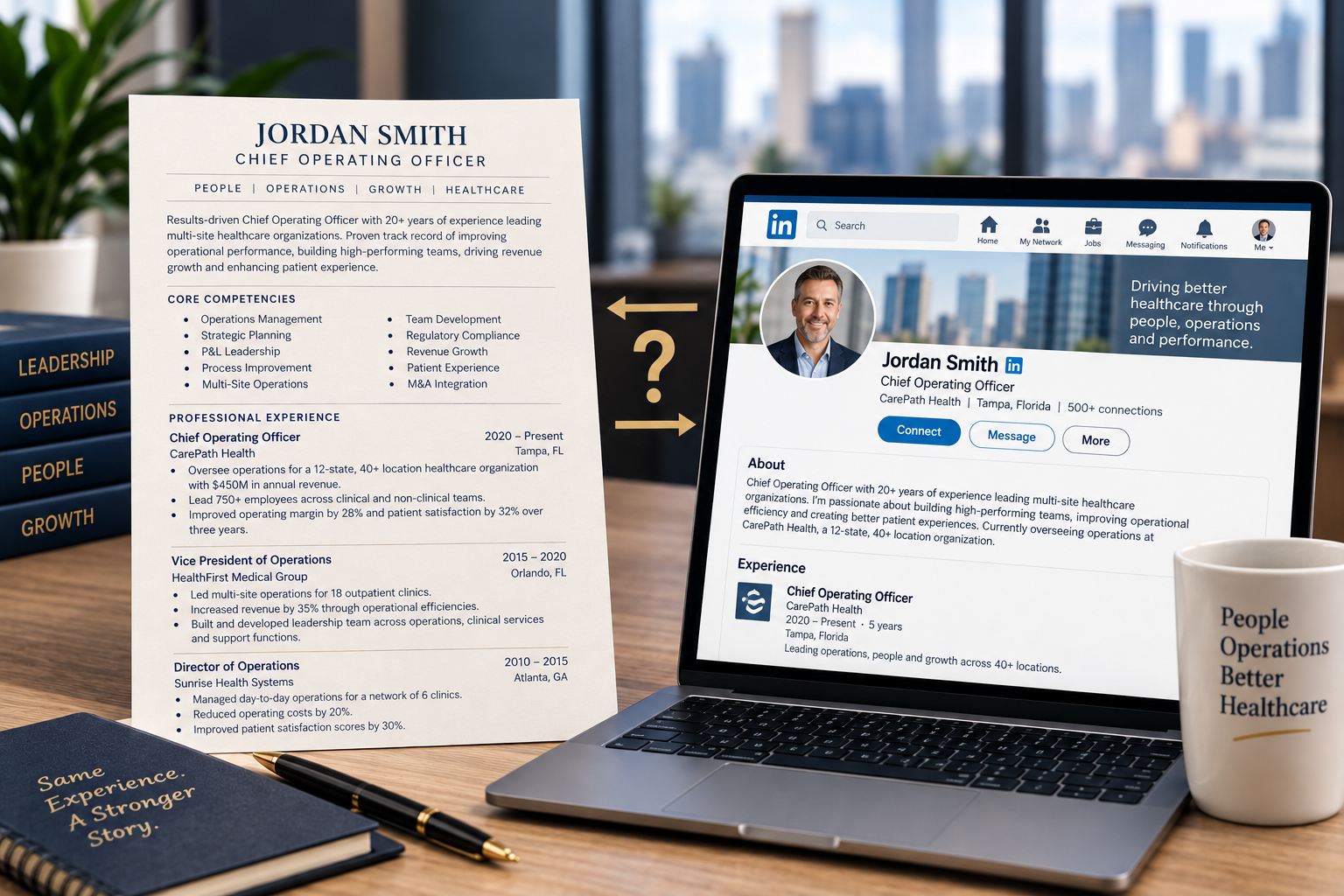
One of the things I find myself pointing out regularly when I review a resume and LinkedIn profile with an experienced professional is that I sometimes feel as though I'm looking at two different people.
Neither one is necessarily bad. The resume may be well written and the LinkedIn profile may look professional. The problem becomes apparent when I put them next to each other. The resume is positioning someone for one kind of opportunity while LinkedIn is still describing the career they had five or ten years ago. Sometimes the titles or dates are different. Other times the information is technically consistent, but the two leave me with completely different impressions of who the person is professionally.
If I'm seeing that during a Strategy Session, an employer or recruiter can see it too.
I think this matters even more after 50 because there is usually a lot more career history involved. Someone may have spent 25 or 30 years moving through different companies, responsibilities and levels of leadership. At some point they decide what they want to do next and update the resume accordingly, but LinkedIn has often been accumulating information for years. The result can be a resume that says, "This is where I'm going," and a LinkedIn profile that still says, "This is everything I've ever done."
They Should Align Without Being the Same
I don't tell clients that LinkedIn should duplicate their resume. I actually think that's a mistake.
A resume is a positioning document written for a particular type of opportunity. Space is limited, so decisions have to be made about what deserves attention and what no longer contributes very much to the story. LinkedIn has more room. It can provide context, show a broader professional history and allow some personality to come through in a way that usually doesn't belong on a resume.
But when I move from one to the other, I should still recognize the same person.
If the resume presents someone as an operations executive and LinkedIn makes them look primarily like a consultant, I'm going to wonder which direction is accurate. If a major accomplishment is central to the resume but barely appears on LinkedIn, I may wonder why. Different dates and titles can create questions as well, even when there is an innocent explanation.
None of these things necessarily disqualifies someone. What concerns me is that they create questions the candidate didn't need to create.
An employer looking at an experienced candidate is already trying to understand a fairly substantial career. I wouldn't make that person work harder by giving them two versions of it.
Look at Them the Way an Employer Will
When I'm reviewing these with a client, I don't think about the resume first and LinkedIn second. I look at what happens when someone sees both.
Do they point toward the same kind of opportunity? Is the level of responsibility consistent? Do the most important parts of the person's experience come through in both places? If the career direction has changed, has LinkedIn changed with it? Most importantly, after looking at both, do I have a clearer understanding of what this person could do for an employer now?
That last question gets lost surprisingly often. Experienced professionals understandably spend a lot of time documenting what they've done. After a long career, there is plenty to document. But an employer isn't simply verifying a career history. They are trying to decide whether that history makes sense for the problem they need someone to solve today.
This is also why I look at the resume and LinkedIn as part of the broader executive job search strategy, rather than treating them as separate projects.
Changing one without looking at the other can solve one problem and accidentally create another.
I don't expect the two to use the same language or contain exactly the same information. I do expect them to make sense together. When an employer finishes reading the resume and then opens LinkedIn, there shouldn't be a moment when they have to stop and figure out which version of the candidate they're actually considering.
For an experienced professional, there is too much value in a long career to let that kind of unnecessary confusion get in the way.
Work With Mike
Ready to Make Sure Your Resume and LinkedIn Tell the Same Story?
In a Strategy Session, we'll review both together — the way an employer would — and identify exactly where the story breaks down and how to fix it.